March 4, 2026
Why High Production Does Not Always Mean High Margin
Why High Production Does Not Always Mean High Margin

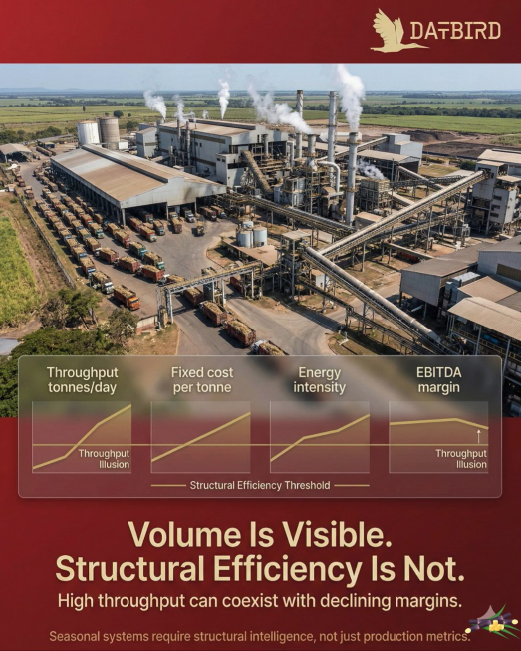
Why High Production Does Not Always Mean High Margin
Most seasonal plants celebrate production milestones.
Higher crush volumes.Higher milk intake.
Higher throughput.But in asset-heavy industries, more production does not automatically translate into stronger margins.
Throughput is an operational metric.
Margin, however, is a structural outcome.In sugar and dairy systems, production often rises while structural efficiency quietly weakens.
This happens when:
Throughput increases but fixed-cost absorption remains misaligned
Higher fibre or lower sucrose shifts processing intensity
Plants operate at higher volumes but energy per tonne rises
Seasonal windows compress, forcing inefficient loading patterns
On the dashboard, production looks strong.
But structurally, the system may be extracting less value per unit processed.
This is why throughput metrics can create a dangerous illusion of performance.
Consider a typical 5,000 TCD mill.If the plant increases crush volume by 6–8% but:energy intensity rises by 4%recovery volatility increases by 0.1–0.2%downtime sensitivity shifts during early-season peak
The result is not margin expansion.Instead, the system may quietly compress EBITDA by ₹3–6 crore over the season.
Not because the plant produced less.
Because the cost architecture per tonne moved in the wrong direction.
The dashboard celebrates volume.
The balance sheet absorbs structural inefficiency.
This is not a production problem.It is a measurement problem.
When leadership teams focus on:tonnes crushedlitres processeddaily throughputwithout simultaneously evaluating:energy intensityyield sensitivityseasonal fixed-cost absorptionthey are optimizing activity, not value extraction.
In seasonal industries, structural profitability is rarely determined by how much you produce.
It is determined by how efficiently the system converts throughput into margin.
High production can coexist with declining profitability.
That paradox is often the first signal of structural drift.
Before the next crushing or flush season review, the sharper question may not be:
“How much can we produce?”
But rather:“Is our system converting throughput into margin efficiently?”
if you want clarity on that before the next seasonal cycle, that is a conversation worth having.
Our latest news and trending topics