February 16, 2026
When Recovery % Becomes a Vanity Metric
When Recovery % Becomes a Vanity Metric


When Recovery % Becomes a Vanity Metric
Most sugar mills celebrate recovery % as the ultimate performance scorecard.
Boards compare it. Plants compete on it.
Annual reports highlight it.But recovery % alone does not tell you how much value you truly extracted from the cane.
In the Sugar industry, recovery is measured as crystal sugar output per tonne of cane.
It is visible. It is benchmarked. It is easy to compare.
But sucrose does not disappear when it doesn’t crystallize.
It moves.Into molasses. Into fermentation losses. Into inefficiencies across ethanol and co-generation integration.
When mills optimize only for visible recovery %, they risk:Ignoring sugar retained in molasses
Under-analyzing total sucrose balance
Overlooking boiling house control driftMissing integration gaps between mill and distillery
The structural leak isn’t low recovery.It is incomplete value capture across the integrated value chain.
Consider a mill crushing 14 lakh tonnes per season.
At 10% recovery, visible sugar output is 1.4 lakh tonnes.Now assume:
Molasses sugar loss increases by just 0.1% due to process drift.
That’s:14,00,000 × 0.1% = 1,400 tonnes additional sucrose not crystallized.At ₹34,000 per tonne sugar equivalent:₹4.7 crore value shift.
Even if part of this is monetized through ethanol, conversion inefficiencies and yield variation mean the full potential is rarely realized.
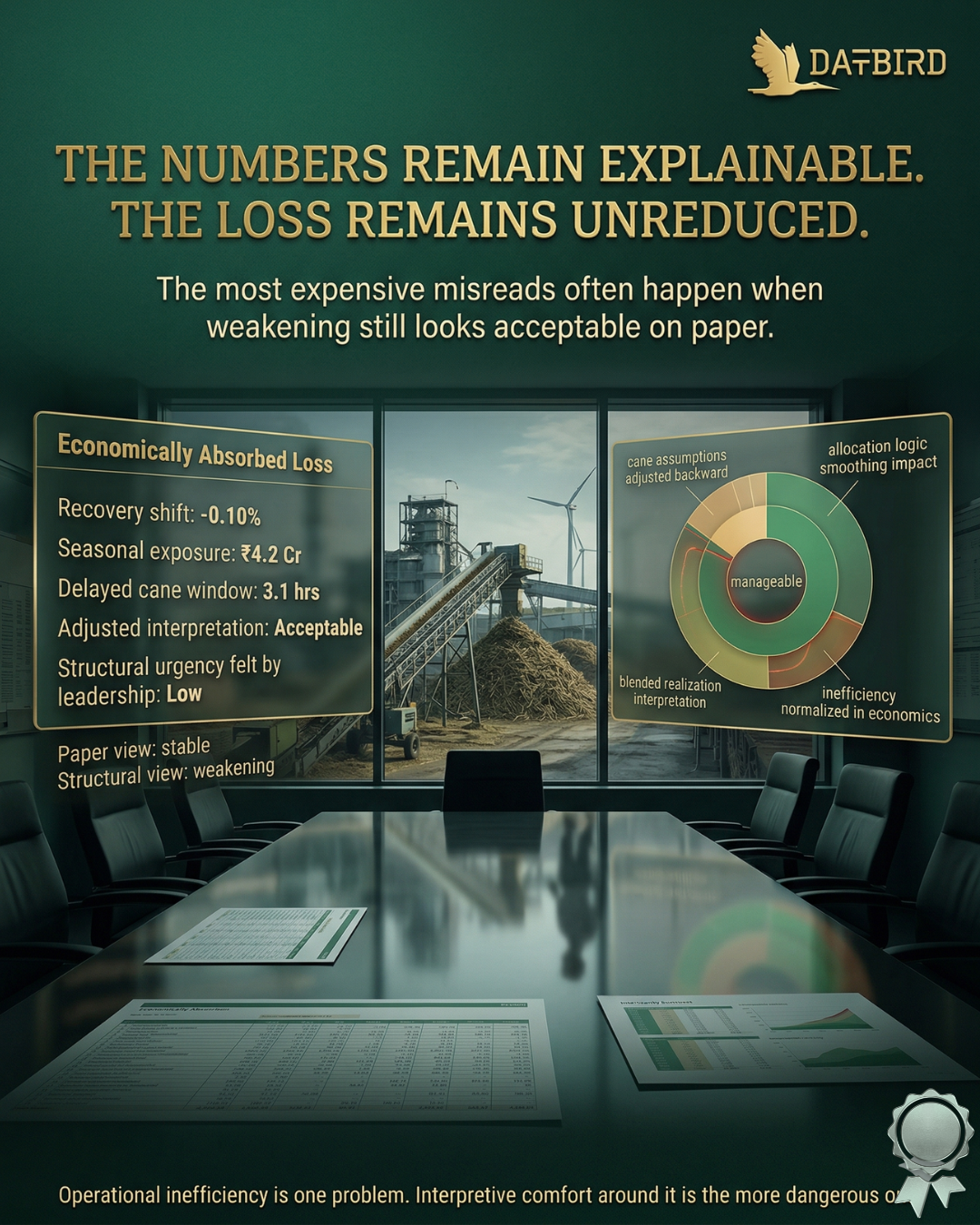
Recovery % may remain stable.
But total sucrose realization efficiency may be quietly declining.
Boards rarely track that metric.Most performance reviews ask:
“What is our recovery compared to regional average?”
Few ask:What is our total sucrose extraction efficiency across mill + distillery?How much value is retained in molasses beyond optimal threshold?
Are we measuring integrated recovery — or siloed outputs?
This is not a plant benchmarking issue.It is a system design issue.
Before expanding ethanol capacity…
Before committing to higher blending volumes…
Before celebrating marginal recovery improvements…
The more relevant question is:Are we optimizing for visibility — or for total value extraction?
Clarity about integrated recovery precedes expansion decisions.
If you want to understand how much structural value may be hidden behind a stable recovery %, let’s have that conversation.
Because in asset-heavy industries, the most dangerous profit leaks are the ones that look like success.
Our latest news and trending topics