February 27, 2026
When Power Spend Looks Stable — But Energy Intensity Is Rising
When Power Spend Looks Stable — But Energy Intensity Is Rising

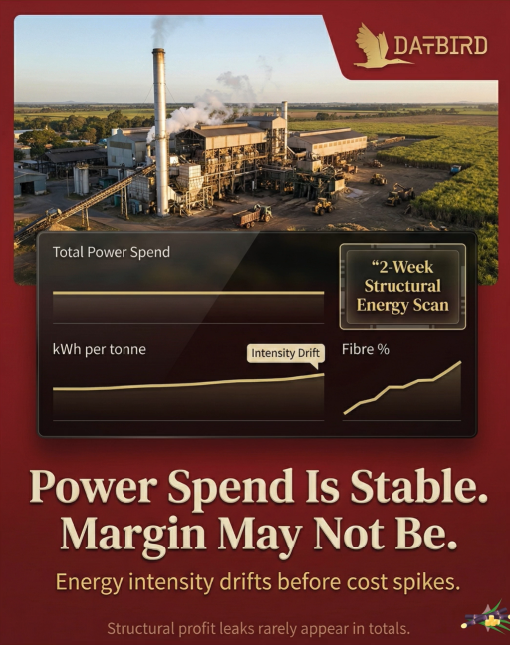
When Power Spend Looks Stable — But Energy Intensity Is Rising
Most mills review total power cost and conclude:
“Energy is under control.”
If the absolute spend hasn’t moved materially, the assumption is stability.
In seasonal, asset-heavy industries — that assumption is often wrong.
Total power spend is a lagging, blended number.
What actually determines structural profitability is energy intensity — kWh per tonne crushed, processed, or evaporated.
Here’s where drift hides:Throughput fluctuates across the season.
Cane quality shifts (fibre %, moisture, maturity).
Downtime alters load profiles.
Auxiliary systems run at sub-optimal efficiency.
If kWh per tonne rises gradually while total spend remains flat (due to tariff adjustments, negotiated contracts, or shorter crush windows), leadership sees “cost stability.”
But structurally, the mill is consuming more energy per unit of output.
That is not a cost issue.It is a design alignment issue between:
Capacity loading
Process balance
Cane composition
Power integration strategy
Consider a 5,000 TCD mill operating 140 days.
If energy intensity drifts upward by just 4–5%:At ₹6–7 per kWh
Across total seasonal consumption
The impact can quietly translate into ₹2–4 crore of margin compression.
Not because tariffs rose.
Not because procurement failed.
Because intensity increased while dashboards tracked totals.
Now layer this over:
Higher fibre due to ratoon creep
Early-season immature cane
Suboptimal turbine loading
You are not just paying more for power.
You are structurally suppressing EBITDA during the most margin-sensitive window of the season.
This is not an operations reprimand.It is a clarity gap.
Before asking:“How do we reduce power cost?”
The sharper question is:“Is our energy intensity structurally aligned with seasonal throughput and cane composition?”
In asset-heavy agro systems, small intensity drifts compound faster than visible overruns.
By the time total cost spikes, the structural misalignment has already embedded itself into seasonal margin.
Power stability can coexist with margin compression.The signal is in intensity, not in totals.
If you want this clarity before your next crushing or flush season review, let’s talk.
Our latest news and trending topics