March 7, 2026
High crushing volumes are usually celebrated as operational success.
High crushing volumes are usually celebrated as operational success. More cane processed. More output. More activity across the plant.

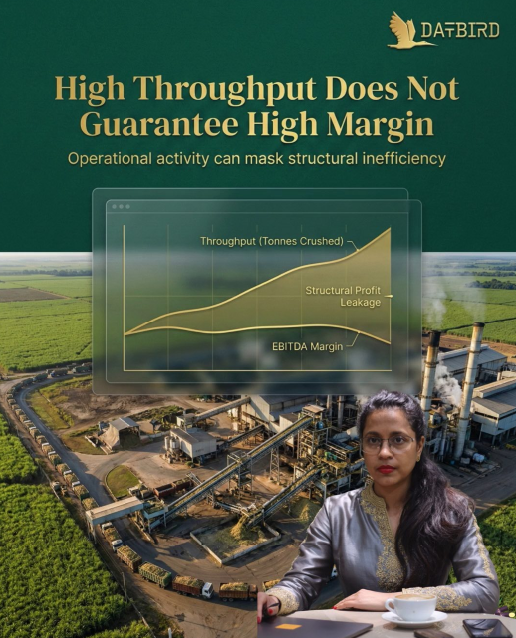
High crushing volumes are usually celebrated as operational success.
More cane processed. More output. More activity across the plant.
But in seasonal processing industries, higher throughput does not always translate into stronger margins.
Throughput is an operational indicator.
Margin, however, is a structural outcome.In many sugar and dairy plants, the system can process larger volumes while the underlying economics quietly weaken.
This happens when structural variables drift:
• fibre % increases, raising energy load
• cane freshness deteriorates during peak supply windows
• variety mix dilutes average sucrose content
• auxiliary systems run above optimal intensity
The dashboard celebrates the tonnage.
But the system may be extracting less value per tonne processed.
Consider a mill crushing 12–14 lakh tonnes in a season.
If throughput rises by 5–7% but structural efficiency shifts slightly:
• energy intensity rises by 4–5%
• recovery declines by just 0.1–0.15%
• fibre content increases marginally
The combined impact can translate into ₹4–7 crore of margin compression across the season.
Production increases.Activity increases.Yet structural profitability weakens.
This is not simply an operational issue.It is often a measurement problem.
When leadership reviews performance primarily through:
• tonnes crushed
• daily throughput targets
• plant utilizationthey may miss the structural variables that determine margin integrity.
In asset-heavy seasonal systems, the real question is not:“How much did we process?”
It is:“How efficiently did the system convert throughput into value?”
High throughput can coexist with declining profitability.
That paradox is often the first signal of structural drift inside the system.
Before the next crushing season review, the sharper question may be:Is our mill converting throughput into margin efficiently?If you want clarity on that before the next seasonal cycle, that is a conversation worth having.
Our latest news and trending topics