March 31, 2026
Downtime reporting is comfortable. Yield timing analysis is not.
Downtime reporting is comfortable. Yield timing analysis is not.

Downtime reporting is comfortable.
Yield timing analysis is not.
Most mills review total downtime % and conclude:“Maintenance is under control.”
Operationally, that may be accurate.
Structurally, it may be incomplete.
In seasonal industries like sugar and dairy, value is not evenly distributed across time.
• Sucrose peaks within narrow maturity windows.
• Fibre shifts compress effective crush opportunity.
• Flush cycles concentrate fat and SNF potential.
• Throughput alignment becomes more valuable than raw uptime.
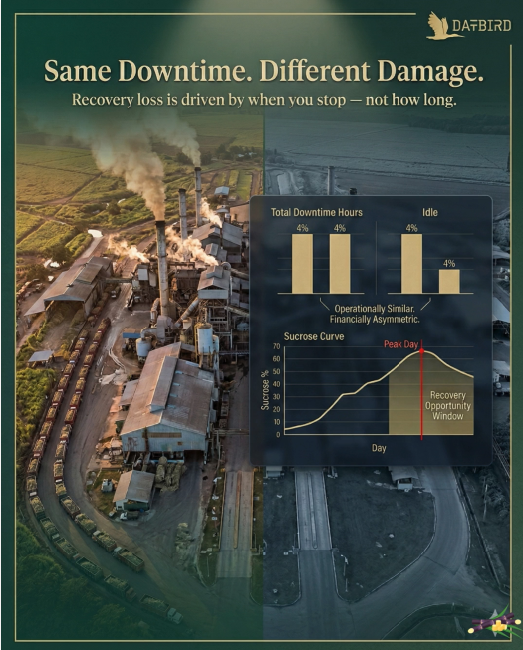
Two plants can report identical downtime — 4%.
But if one loses 5 high-sucrose peak days inside maturity,while the other loses 5 shoulder days,the financial impact is not comparable.
Even a 0.15% recovery opportunity loss on a 12 lakh tonne crushcan translate into multi-crore margin compression.
The board sees 4%.The P&L absorbs timing asymmetry.
The deeper question is not:“How many hours did we lose?”
It is:“Where did downtime intersect with peak chemical opportunity?”
If downtime analysis is not layered against:
• Sucrose curve progression
• Fibre trend shifts
• Throughput compression windows
• Recovery volatility bandsthen you are auditing mechanics — not structural yield.
And that is a clarity issue before it becomes a capex issue.
Before your next crushing or flush season review,it may be worth examining whether downtime reporting reflects value timing — or simply hours logged.
If that distinction matters at board level, the conversation is worth having.
Our latest news and trending topics