March 5, 2026
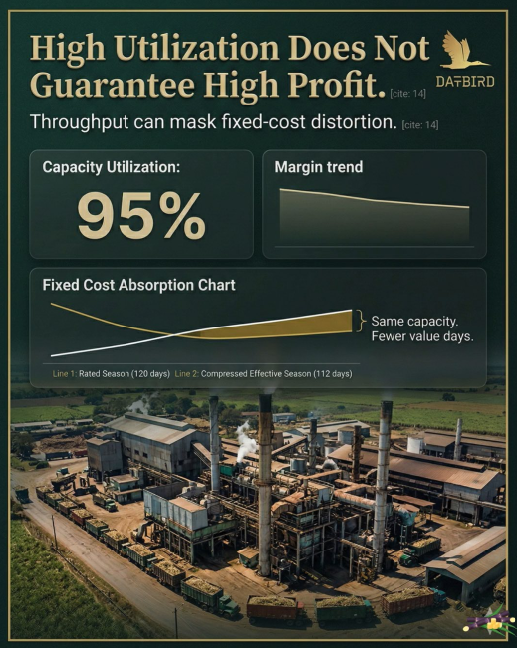
95% Capacity Utilization — And Still Losing Money.
95% Capacity Utilization — And Still Losing Money.

95% Capacity Utilization — And Still Losing Money.
Many seasonal plants proudly report 90–95% capacity utilization.
The board sees high throughput and assumes efficiency.
But high utilization does not guarantee structural profitability.
In sugar and dairy operations, capacity utilization is often treated as a performance proxy.
It is not.Utilization measures how much of installed capacity was used.It does not measure:
• Whether fixed costs were optimally absorbed
• Whether high-cost days diluted margin
• Whether seasonal window compression inflated cost per unit
• Whether throughput aligned with peak value concentrationIn seasonal plants, fixed costs are front-loaded and time-bound.If the crushing or flush window compresses by even a few days,the same annual fixed cost must be absorbed over fewer effective high-value tonnes.
The plant can run at 95% of rated daily capacity —and still under-absorb structural cost.
That is not an operational issue.It is a seasonal design issue.
Consider a conservative illustration:
• Installed capacity: 12,000 TCD
• Crushing season target: 120 days
• Fixed cost base: ₹120 crore annuallyIf effective high-value crushing compresses by 8 daysdue to cane maturity shifts or staggered intake:
You are now absorbing ₹120 crore over 112 value-productive days instead of 120.
That increases fixed cost per effective day by over 7%.On a 12 lakh tonne season,even a ₹80–₹100 per tonne fixed cost distortiontranslates into ₹9–12 crore margin compression.
The plant reports 95% utilization.
The P&L absorbs structural inefficiency.Most boards ask:
“What was our average utilization?”
The sharper question is:“Did our throughput timing optimize fixed-cost absorption across the highest-value days?”
Until utilization is layered against:
• Season length compression
• Recovery variability• Fibre and composition shifts
• Peak-margin window mapping
• Fixed-cost absorption per value-tonneyou are measuring volume — not structural efficiency.
This is a clarity problem before it becomes a cost-cutting problem.
Cutting maintenance or labor will not solve a seasonal absorption distortion.
Before your next crushing or flush season review,it may be worth examining whether your capacity metrics reflect structural profitability — or simply operational activity.
If that distinction matters at board level, the conversation is worth having.
Our latest news and trending topics